On a cold winter evening in 2018, I was enjoying one of my favourite beverages when my phone rang.
It was my brother-in-law.
“Hi Thabix, there’s something I’ve been thinking about for a while. I think a taxi app could really do well in this country.”
My response was immediate and enthusiastic. “You know what, my brother? I’ve thought about that too! I’ve just always been held up with work. But I think it can work!”
A few days later, we met at the same spot to discuss the idea. He had contacts for a software developer in India who, we were told, had developed one of Nigeria’s biggest taxi apps.
At the time, ride-hailing services were gaining momentum in South Africa. In Botswana, the market appeared to be waiting for someone to take the initiative. We asked ourselves a simple question: “Why not Botswana?”
That conversation would lead to the birth of Emafoo, one of the most expensive entrepreneurial lessons of my life.
And strangely enough, whenever I walk past the clothing stalls at the bus rank, or see another new clothing brand being advertised on Facebook, I am reminded of that experience. Because the fundamental problem is often the same.
An idea can make perfect sense to the entrepreneur and still fail to make sense to the customer.
Emafoo: when a brilliant idea meets the marketplace
Our vision was straightforward. Build a Botswana-owned ride-hailing platform that would connect local taxi drivers with customers through a mobile application.
We had an additional proposition that we believed would make the business irresistible. Instead of taxi drivers simply using a foreign-owned platform, why not give them ownership in their own local platform? Under our proposed model, participating taxi drivers would collectively own 50% of the business. They would become shareholders, users and ambassadors.
It sounded brilliant. At least to us.
Our first major obstacle was financing the software. We contacted the developers, and the proposed solution was a white-label application that we could customise and brand for Botswana. The price? US$30,000. We needed to raise substantial capital before the business could even begin operating.
I turned to something I had learned throughout my entrepreneurial journey: your network is your net worth. I approached an old associate who knew me, trusted my entrepreneurial enthusiasm and was receptive to the idea. He listened and said something along the lines of: “That sounds like a brilliant idea. Let’s meet up. But I have to bring my partner with me.”
The discussions progressed. I raised funds from associates, family and my own resources. My recollection of the initial capital mobilisation is approximately:
| Funding source | Amount |
|---|---|
| Business associates | P50,000 |
| Family | P60,000 |
| My own resources | P210,000 |
| Total | P320,000 |
The capital went towards building the business, including the software commitment and operational preparation. Once again, I had relied on my reputation, relationships and ability to persuade people to believe in a business idea.
But there was something I had not fully appreciated. Convincing investors to believe in an idea is very different from convincing customers to use the product.
We had the technology. But did we have the market?
We went out to recruit taxi drivers. We visited taxi clusters around Gaborone, including those operating around the shopping malls.
Our pitch was simple. Why should Botswana taxi drivers surrender the future of their industry to foreign-owned technology companies when they could collectively own a significant stake in a local platform? We talked about protecting the local market, building wealth and giving drivers a direct interest in the technology that could shape their livelihoods.
But the response was not what we expected. Our enthusiasm did not automatically translate into their enthusiasm.
We were selling long-term ownership to people who were more concerned about immediate income. We were talking about future shareholder value. They were asking a more practical question: “How much money will I make from this today?”
That was one of our first major mistakes. We were selling what we believed customers should value, rather than understanding what they actually valued. It is a mistake I now recognise in many other businesses. Including the clothing business.
Then the competition arrived
By December 2019, we had still not launched properly. The software development process had been frustrating. The application would crash during testing. We would report the problems to the developers, and they would attempt to fix them. Then we would test again. And discover more problems. The developers controlled the source code, limiting our ability to resolve technical issues independently.
Meanwhile, the market was changing. InDrive was entering Botswana. The window of opportunity we thought we had was closing.
One of the investors decided to withdraw, and I had to find P60,000 from my other business activities to settle the withdrawal. By then, I had also diverted working capital from my accounting practice into Emafoo. The business had become an expensive commitment.
We employed three people in sales and marketing, two in customer support and one in software development. We had investors, employees, developers, prospective customers, drivers and operating expenses to manage. What we did not have was a reliable source of revenue.
We were burning P60,000 a month with no revenue
We eventually conducted a soft launch in early 2020. We tried to remove obstacles that might prevent drivers from using our application. We purchased tablets and SIM cards with data for the first 20 drivers because internet access was a practical challenge. We invited drivers to our offices for a fully catered lunch so we could explain the business, build relationships and encourage adoption.
We were trying everything we could think of. But the economics of the competing platforms were working against us.
At the time, InDrive was not charging drivers a commission on rides, while our model charged 12%. We considered that commission necessary to generate revenue and sustain the business. But from the drivers’ perspective, why should they pay us when a competing platform was allowing them to operate without that commission?
Some viewed us with suspicion. We were even described as online scammers. The few customers who used the application became frustrated by technical problems and the limited availability of drivers.
We were caught in a difficult cycle. Customers would not use the app because there were too few available drivers. Drivers would not commit to the app because there were too few paying customers. And without sufficient completed rides, we had little prospect of earning meaningful revenue.
We were spending more than P60,000 every month while generating virtually no revenue. That situation continued for over ten months.
We had developed the product. We had raised money. We had employed people. We had recruited drivers. We had invested in marketing. But we had not established a sustainable business model.
Emafoo taught me a painful lesson: building a product is not the same as building a market. And that brings me to the bus rank.
The mystery of the clothing stalls at the bus rank
For years, one question has fascinated me. How can scores of hawkers and clothing stalls operate in the same place, selling what appears to be almost exactly the same merchandise?
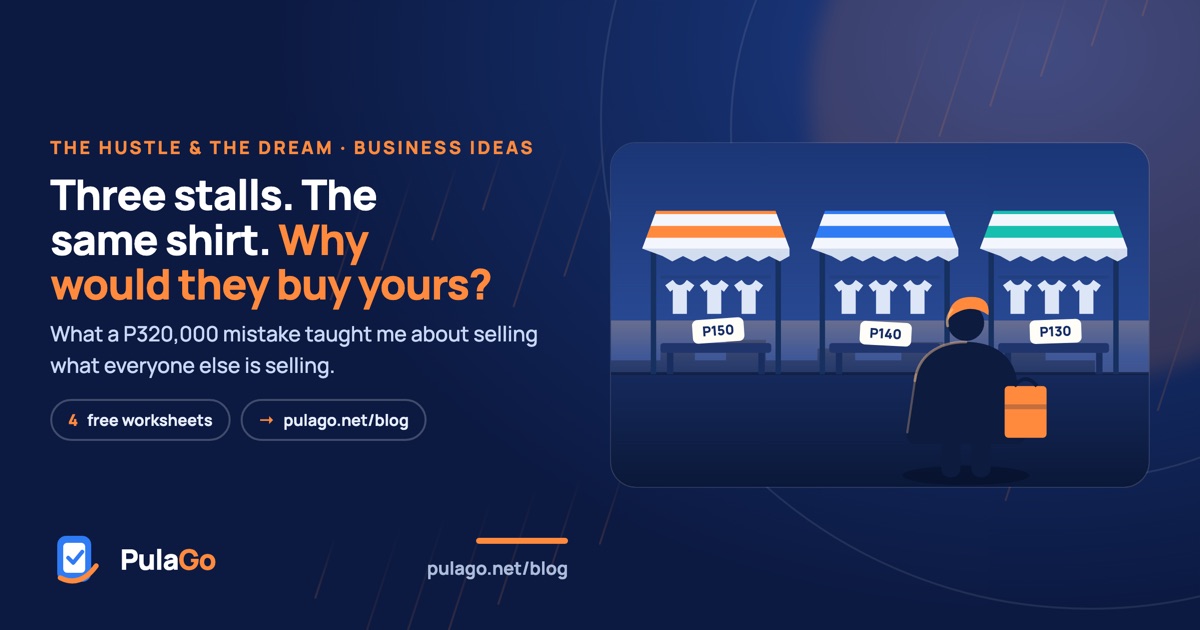
Walk through a busy bus rank in Botswana and you may find several sellers offering similar T-shirts, jeans, dresses, shoes and accessories. One stall sells an item for P150. Another stall, a few metres away, sells something very similar for P140. A third seller offers what appears to be the same product for P130.
What makes a customer choose one seller over another? Price? Friendliness? Location? Trust? Availability of sizes? The ability to negotiate? Or simply the fact that the customer happened to stop at that particular stall?
Let me be clear: hawkers are entrepreneurs too. Many have developed exceptional skills in customer relationships, stock selection, negotiation and cash management. Their businesses provide incomes and support families. Some have built loyal customer bases over many years.
But I believe there is a strategic question every clothing seller should ask:
If someone opened a stall next to yours tomorrow, selling exactly the same clothes at the same price, why would your customers continue buying from you? If you cannot answer that question, your business may be more vulnerable than you realise.
That is what Emafoo taught me. We thought local ownership was our competitive advantage. Our drivers and customers did not value that advantage enough to change their behaviour.
The same problem can arise when a clothing entrepreneur believes that simply having good-looking merchandise, a fashionable logo or a new clothing brand is enough.
A clothing brand is not just a logo on a T-shirt
We are seeing more aspiring entrepreneurs developing their own clothing brands in Botswana. Entrepreneurship and creativity should be encouraged. But I often wonder how many people have asked themselves why a customer should buy their clothing instead of an existing alternative.
A brand is not simply a logo printed on a T-shirt. A brand is the expectation customers develop about the value, quality, identity and experience associated with your business.
Imagine three clothing businesses.
- Business A buys generic T-shirts, prints its logo on them and sells them for P250.
- Business B sells T-shirts designed specifically for customers who struggle to find suitable sizing, with dependable measurements, quality fabric and alterations where needed.
- Business C builds a clothing range around a particular community or lifestyle, develops original designs that resonate with that audience and earns its loyalty.
All three sell T-shirts. But they are not necessarily selling the same value. Business A may have to compete heavily on appearance, popularity and price. Business B is solving a practical problem. Business C is appealing to identity and belonging.
Any of these models could succeed or fail. The important difference is whether the entrepreneur has identified a reason why customers would choose the product repeatedly.
Before asking how to manufacture 500 T-shirts, ask why 50 people would want to buy the first 50.
How can a clothing seller stand out in Botswana?
Let us consider some possible strategies.
Specialise in a specific customer. Rather than selling every type of clothing, you could specialise in clothing for a particular group of customers. Examples worth researching include:
- Affordable professional wear for young working women
- Plus-size clothing with reliable measurements and fitting advice
- Durable workwear for artisans and technicians
- Children’s clothing sold in practical seasonal bundles
- Schoolwear with convenient fitting and ordering arrangements
- Original locally designed casualwear targeting a clearly defined audience
These are opportunities to research, not guarantees of unmet demand. The advantage of specialisation is that it gives you a clearer picture of who your customer is and what matters to them.
Compete on convenience. Perhaps customers can order through WhatsApp and collect their purchases near their homes or workplaces. Perhaps you provide clear measurements, reliable stock information and predictable delivery. A seller who makes buying easier may have an advantage even when competitors offer similar products.
Build customer relationships. A hawker who remembers a customer’s preferred sizes, understands their budget and communicates when suitable merchandise arrives is offering something more valuable than a once-off transaction. That relationship can become an advantage.
Build around quality and fit. A clothing brand that consistently delivers the promised quality and sizing can earn repeat customers. Poor stitching, inconsistent sizes and disappointing fabrics can destroy customer confidence very quickly.
Serve a specific geographic market. A seller who understands the preferences and purchasing patterns of customers in a particular neighbourhood may be better positioned than one trying to sell everything to everyone.
The goal is not to be different for the sake of being different. The goal is to be meaningfully better for a particular customer.
Don’t make the Emafoo mistake: validate demand before buying stock
Our mistake with Emafoo was committing substantial capital before we had demonstrated that enough customers and drivers would use the platform under our proposed terms.
Clothing entrepreneurs can make the same mistake in a different form. They travel to purchase stock. They spend P10,000, P20,000 or more on merchandise. They return with clothes they believe people will love. Then they discover that customers want different colours, different sizes, different prices or entirely different products. Money that could have been used for marketing, transport or replenishing popular items is now tied up in unsold stock.
I would suggest a different approach.
- Identify your intended customer. Are you selling to students, working professionals, parents, teenagers, businesses or people looking for a particular style?
- Interview potential customers. Ask what they struggle to find, where they currently shop, what they dislike about their current options and what influences their buying decisions.
- Test the product with a small quantity. Avoid committing your entire budget to a large collection before you know what sells.
- Look for actual purchasing behaviour. Compliments and social media likes are encouraging, but they do not prove that someone will pay. A confirmed paid order is stronger evidence of demand than a hundred comments saying, “I love this!”
- Reorder based on evidence. If one product sells consistently, investigate whether you can supply it profitably and repeatedly.
This is the difference between purchasing merchandise and building an inventory strategy.
Free worksheets: the Customer Interview Worksheet (PDF) is one printable page per conversation, and the Competitor & Differentiation Canvas (PDF) is where you write down the three sellers you are up against and what would make a customer leave them for you. Speak to at least 20 buyers before you decide there is demand.
The numbers: revenue is not profit
Let us imagine a Botswana clothing entrepreneur importing a small batch of garments for resale. Here is a hypothetical calculation for one item.
| Item | Amount |
|---|---|
| Selling price | P350 |
| Supplier purchase cost | P180 |
| Allocated freight, duties and other landed costs | P35 |
| Packaging | P10 |
| Delivery or selling costs paid by seller | P25 |
| Contribution per item | P100 |
The entrepreneur sells the item for P350, but only P100 remains after the illustrated variable costs. That P100 must still contribute towards fixed expenses such as rent, internet, advertising, salaries and other overheads before the business earns a profit.
If fixed costs are P3,000 per month: break-even units = P3,000 ÷ P100 = 30 items. Under those assumptions, the entrepreneur must sell 30 items simply to cover monthly fixed costs.
Selling 30 items does not mean earning P10,500 in profit. It means the P3,000 contribution has covered the fixed costs. Returns, discounts, damaged stock and unsold seasonal inventory could make the actual result worse.
This is why I believe every clothing seller should understand the numbers behind their business. A busy shop is not necessarily a profitable shop. And an expensive clothing brand is not necessarily a successful one.
Free spreadsheet: the Clothing Business Starter Toolkit (Excel) has a Stock & Pricing tab that does this calculation per product and totals it — landed cost, contribution per unit, margin, break-even units and the value of the stock still sitting unsold. It opens on a sample product mix of its own, deliberately not the single P350 item above, so you can see the arithmetic working before you clear it and enter your own supplier quotes.
If you want to see that calculation done line by line on a different kind of business, The Pula Challenge #1 works through a P1,500-a-month cleaning contract and shows how a P200 surplus turns into a P50 loss once the overheads are allocated. The arithmetic is the same arithmetic.
Social media followers are not the same as customers
Another lesson I learned from Emafoo concerns the difference between attention and adoption. We could explain our platform to taxi drivers. We could invite them to meetings. We could give them tablets and data. But none of those activities guaranteed that they would use the app consistently.
In the clothing industry, the equivalent might be a Facebook page with thousands of followers but very few paying customers. Likes do not pay suppliers. Comments do not cover rent. Views do not automatically turn into sales.
Social media should be used to create demand, build trust and help customers make purchasing decisions. For example, rather than posting photographs of clothing with only the caption “Available, inbox for price,” consider providing:
- Clear prices and available sizes
- Actual photographs or videos showing the fit
- Styling suggestions for different occasions
- Information about fabric and care
- Customer reviews shared with permission
- Ordering, delivery and return information
Make it easy for someone to understand what you sell, why it is suitable for them and how they can purchase it.
And measure what matters. How many enquiries turn into orders? How many customers buy a second time? Which products sell without heavy discounting? Which items remain unsold? Your customer data can teach you more about your business than the number of reactions to your latest Facebook post.
The business model matters more than the business idea
When we started Emafoo, we focused heavily on the taxi app itself. But the app was only one component of the business. The real challenge was creating a marketplace where drivers and passengers had enough reasons to participate. The commission model also had to make economic sense to the drivers. We had not solved those problems adequately.
A clothing business faces its own set of business-model questions. Will you import and resell ready-made clothes? Will you manufacture your own designs? Will you operate a stall, sell online or use a combination of channels? Will you produce clothing after receiving orders? Will you hold inventory or work with a supplier who can replenish stock quickly? Will you sell directly to individuals or supply other businesses?
Each model has different costs, risks and opportunities. A clothing brand producing custom garments after confirmed orders may have lower unsold-inventory risk but longer delivery times. A bus-rank seller with ready stock may benefit from immediate purchases and foot traffic but face intense price competition. An online boutique may have lower premises costs but higher customer-acquisition, delivery and returns challenges.
There is no universally superior business model. The right one is the model that creates value for customers and generates sustainable returns for the entrepreneur.
Registering a clothing business in Botswana
If you are planning to establish a clothing shop, street-vending business or clothing brand, formalisation and compliance should form part of your business plan. Business and company registrations are handled by the Companies and Intellectual Property Authority (CIPA).
Botswana’s official trade guidance identifies General Clothing as a trade category reserved for citizens or wholly citizen-owned companies. Depending on the business activity and circumstances, you may require a trade licence or business registration certificate. Street hawkers and vendors must also investigate the requirements of the relevant local council. If you intend to manufacture clothing rather than only resell it, additional industrial registration or licensing rules may apply.
You should also consider tax registration, import requirements, employment obligations and protection of any original brand name or logo. Helpful resources include:
- PulaGo — business registration and compliance: Company registration, BURS registration and the filings that follow.
- CIPA — company, business name and intellectual property services: Registration and trademark applications.
- Botswana Trade eServices: Trade licences, business registration certificates and application steps.
- Government of Botswana — trade licence information: Official guidance on trade categories and supporting documents.
- BURS — Botswana Unified Revenue Service: Tax registration and taxpayer obligations.
- BURS — customs clearance: Import declarations, classification and duties.
- City of Francistown — informal sector: An example of a council’s street-vending and hawker guidance. Check your own council, not this one.
- On-Basic: QuickBooks Online subscriptions, stock records and business financial systems.
Two things catch clothing sellers out in particular. The first is importing: a consignment bought to resell is a commercial import, not personal shopping, and the declarations, classification, duties and tax treatment that apply to it are worth confirming with BURS before the stock is on a truck rather than after. The second is the brand itself — if the name or logo is the thing you are building, look at trademark registration through CIPA, because registering a company name is not the same as owning the mark.
Check the relevant authority’s current requirements before committing to a location, manufacturing operation or trading activity. If you would rather read the whole registration sequence in one place, our guide to registering a company in Botswana sets out the order that saves you a month.
Registering a company with CIPA does not by itself authorise you to trade in clothing. Confirm the licence or business registration certificate your specific activity and location require with the responsible trade authority or your council.
Your 30-day clothing business market test
If I were starting a clothing business today, I would not begin by ordering hundreds of garments. I would begin by answering one question: who is my customer, and why would that person buy from me rather than someone else?
Week 1 — Understand the customer. Identify a particular group of customers and speak to at least 20 potential buyers. Find out what they purchase, how frequently, their approximate budgets and what frustrates them about existing sellers.
Week 2 — Study your competition. Visit established clothing shops, markets and relevant online sellers. Compare prices, quality, product selection, customer service and shopping convenience. Look for genuine problems you may be able to solve profitably.
Week 3 — Test the product. Present a small selection of products or prototypes to potential buyers. Where practical and lawful, test demand through a limited batch or paid pre-orders with clear delivery and refund terms. Record customer feedback and actual purchases.
Week 4 — Review the numbers. Calculate your true landed cost, selling expenses, contribution per item, expected stock turnover and working-capital requirements. Then ask yourself whether the evidence justifies investing more money.
If customers are not buying, investigate why before ordering more stock. It may be the product, price, quality, convenience, positioning or the wrong target audience.
A failed market test with a small budget can be far more valuable than discovering the same problem after spending P50,000.
Free printable: the 30-Day Clothing Market Test (PDF) is those four weeks as twelve dated actions, each with the evidence it is meant to produce and a decision to make on day 30.
Your free clothing business starter toolkit
Everything in this article as something you can actually fill in:
- Clothing Business Starter Toolkit (Excel) — customer research, competitor differentiation, a stock and pricing model with live formulas, a 30-day validation plan and a tab of official links.
- Customer Interview Worksheet (PDF) — the questions to ask before you buy inventory, and a line for whether they actually paid.
- Competitor & Differentiation Canvas (PDF) — what the sellers around you already do well, and what would make yours worth choosing.
- 30-Day Clothing Market Test (PDF) — four weeks of dated actions, ending in a scale, revise or stop decision.
The numbers in all four are illustrative. They are planning tools, not supplier quotations, market rates or professional advice.
There is a difference between having something to sell and having a reason to be bought
I sometimes think about Emafoo and how different things might have been if we had approached the market differently. What if we had spent more time understanding what taxi drivers actually valued? What if we had tested the economics of our commission model before committing substantial capital? What if we had validated customer demand and driver participation before building out the organisation?
I cannot know whether those changes would have saved the business. But I know the questions would have been worth asking. I also know that raising money, employing people and launching a product are not proof of business success. Success comes when customers consistently choose your offering, receive value and pay enough for the business to survive and grow.
So, to the aspiring entrepreneur preparing to open another clothing stall: what will make your stall different from the ten others selling similar merchandise? To the young designer planning to launch a clothing brand: why will someone choose to wear your brand rather than the alternatives already available? And to the entrepreneur preparing to spend their savings importing clothes: have you established that enough customers actually want what you are about to buy?
I am not suggesting that entrepreneurs should abandon the clothing industry. Quite the opposite. I believe there is room for innovation in how clothing is designed, sourced, marketed, sold and delivered. But I also believe we need to challenge ourselves to move beyond simply copying what appears to be working for someone else.
The most important asset you can develop is not necessarily a large inventory or a fashionable logo. It is a deep understanding of your customer and the ability to build a business around that understanding.
Emafoo cost me dearly. But it left me with knowledge that has continued to influence my entrepreneurial journey, including the evolution of On-Basic and the vision behind PulaGo.
My challenge to every aspiring clothing entrepreneur in Botswana is this. Don’t just ask yourself what you can sell. Ask yourself why anyone should buy it from you. Your answer could be the difference between another clothing stall and a sustainable business.
If you have tested the idea and you are ready to formalise it, PulaGo is where you register, comply and grow — and for QuickBooks Online, stock records and invoicing, On-Basic is where we do that work.
Before investing your savings, research your market, understand your customer, calculate your costs and prepare a practical business plan. The money you do not lose is the cheapest capital you will ever raise.
The Emafoo account reflects my own recollections and perspectives. The financial examples in the clothing sections are hypothetical and are not guarantees of profitability or Botswana market rates. PulaGo is a private company service and is not affiliated with, endorsed by or part of CIPA, BURS or the Government of Botswana. This article is educational and does not constitute legal, financial or tax advice.